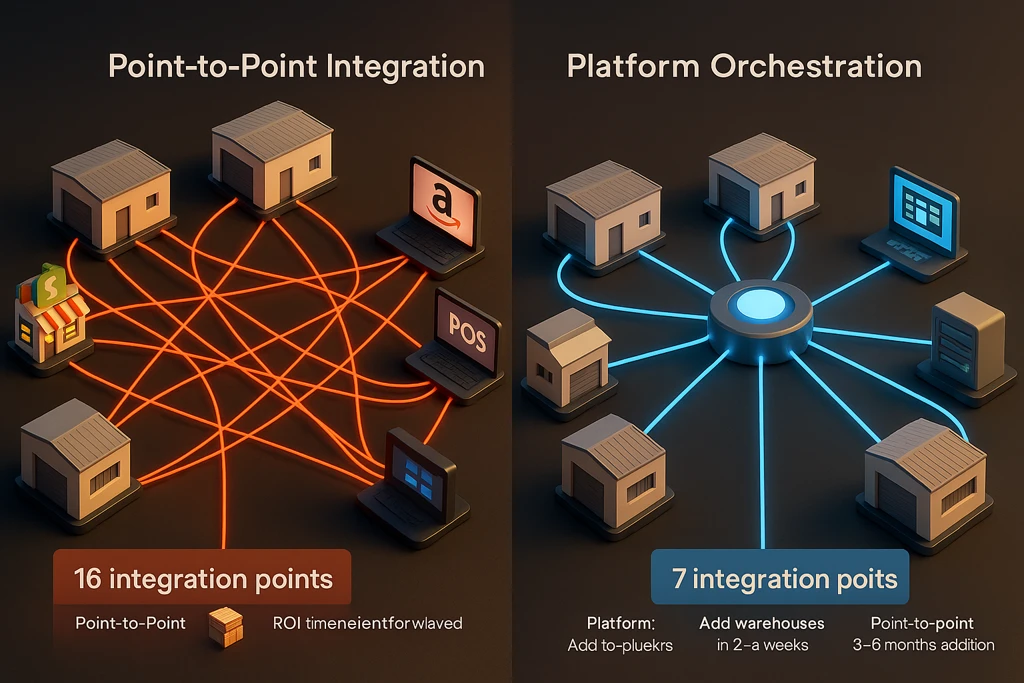
Explore three powerful solutions designed to streamline and scale your operations. Whether you need seamless system integrations, advanced inventory and ecommerce control, or custom portals to digitise workflows, Exsited delivers modular capabilities that connect with the tools you already use.
Exsited is your integration-first operations platform, built to unify your tools, streamline workflows, and support the way your business runs. Choose the capabilities you need. Connect the systems you trust.
TL;DR: Real-time inventory sync requires event-driven architecture, not faster polling. Hybrid approaches combining webhooks (sub-second updates) with scheduled reconciliation (catches the 2-3% webhooks miss) deliver the reliability multi-channel retail needs. Race condition prevention and API rate limiting strategies matter more than raw sync speed. The right architecture scales with volume: polling under 100 orders/day, hybrid for growth, full platform above 500 orders/day.
The Real-Time Lie Most Vendors Tell
Every inventory platform promises "real-time sync across all channels." Most deliver something closer to "real-time-ish sync that works fine until it doesn't."
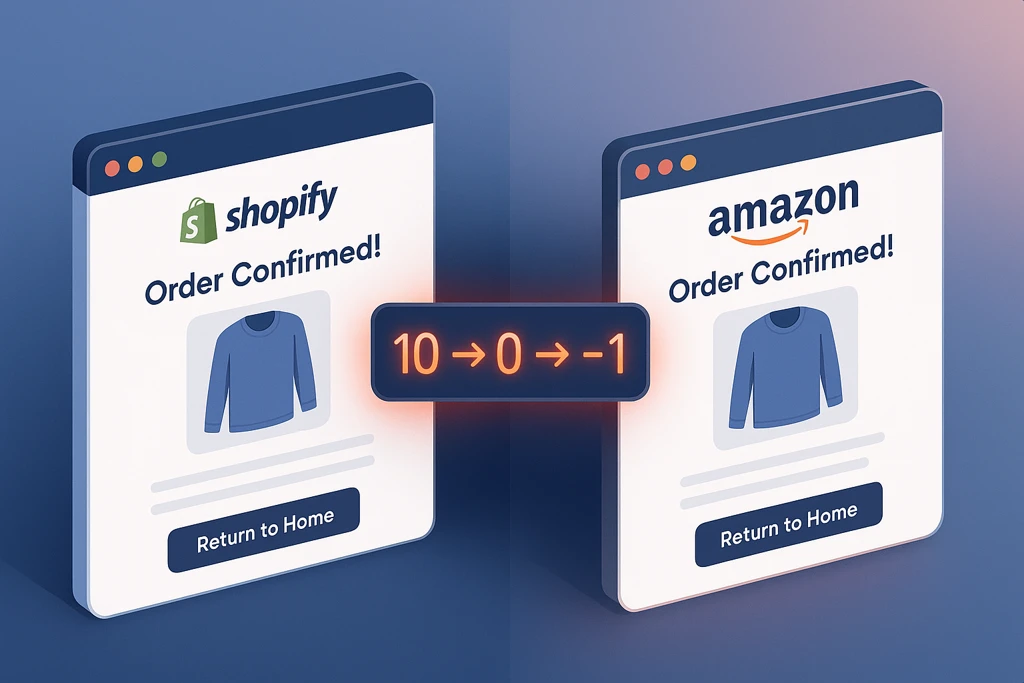
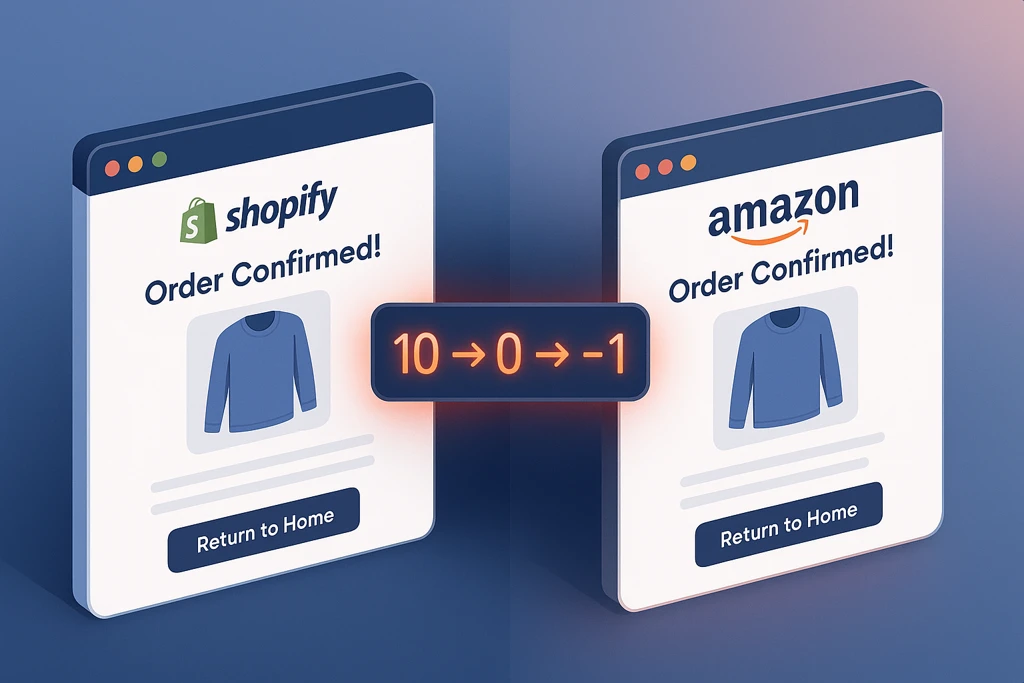
Here's what that looks like in production: A customer orders on Shopify at 2:14pm. Your system shows 10 units available. At 2:15pm, another customer orders the same product on Amazon. Amazon also sees 10 units because the Shopify sale hasn't synced yet. You've confirmed 11 orders for 10 units. The oversell gets discovered Monday morning when customer service Slacks you in all-caps: 'DID WE REALLY SELL THE SAME UNIT TWICE?' Not Saturday night when you still had options.
After architecting inventory sync for 50+ multi-channel retailers, the pattern is clear: "real-time" isn't a polling frequency. It's an architecture. The gap between what real-time inventory sync promises and what it delivers becomes obvious during flash sales, product launches, and holiday peaks.
This guide explains three architectural approaches (webhook-driven, polling-based, and hybrid), why most "real-time" claims fail under load, how to prevent race conditions when multiple channels sell simultaneously, and helps you choose the right architecture based on your order volume and growth trajectory.
Why "Real-Time" Is a Lie (Most of the Time)
Vendors claim "real-time sync across all channels" while delivering polling intervals measured in minutes, not seconds.
If your sync runs every 5 minutes, your inventory has a 5-minute blind spot. During a flash sale processing 50 orders per minute, that's 250 potential oversells before the system catches up.
According to IHL Group's 2023 study, global out-of-stocks cost retailers $1.2 trillion annually. While vendor issues and theft drive most distortion, sync lag during high-volume periods contributes significantly to preventable overselling.
The technical truth: true real-time inventory sync requires event-driven architecture, not faster polling. Most systems marketed as 'real-time' are actually polling.
Three Architectural Approaches Compared
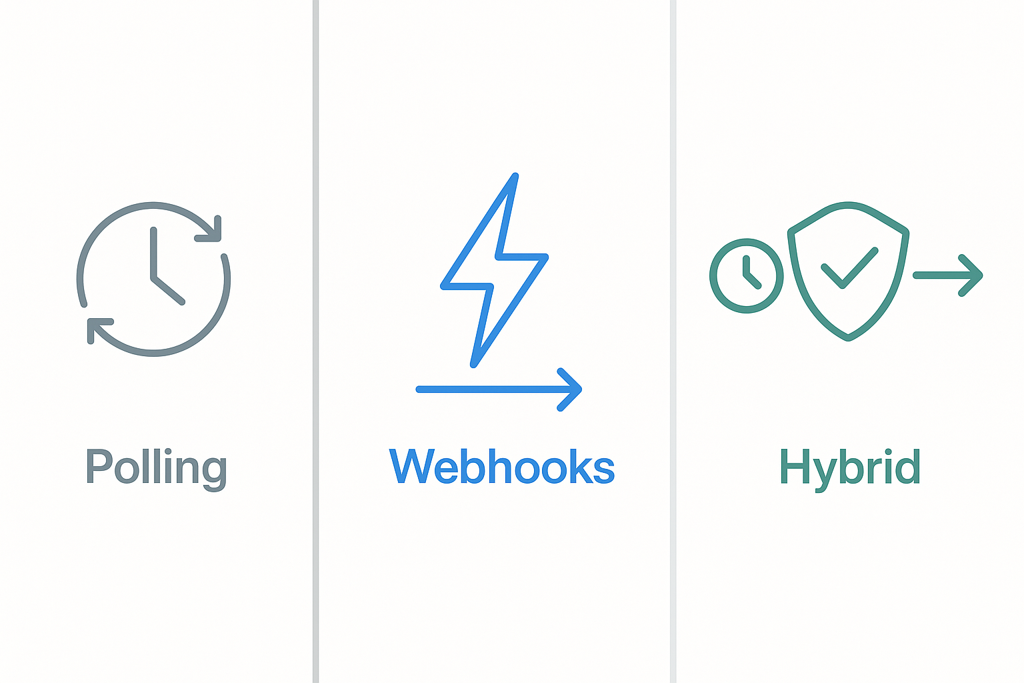
Every real-time inventory sync implementation makes the same fundamental choice: how aggressively do you check for changes, and what happens when that checking mechanism fails?
Polling: Simple Until It Isn't
Most implementations start here because the pattern is straightforward. System A asks System B every few minutes: "Anything new?" If yes, process updates. If no, wait and ask again.
This works for low-volume scenarios. The system is simple to build, easy to debug, and works with any platform regardless of webhook support. There's a reason polling is the default: it's the only approach that works when vendors say "webhook support coming in Q3" for three years running.
Problems emerge under load. That 5-minute interval creates a blind spot where channels can't see each other's sales. During a flash sale processing 50 orders per minute, one retailer oversold 23 units before the next polling cycle caught up. Polling every minute across 5 channels generates 7,200 API calls daily, with 95% returning "no changes."
Polling remains acceptable for channels under 50 orders daily, or as a backup mechanism.
Webhooks: Fast Until They're Not
Webhooks flip the model. Instead of asking "anything new?" repeatedly, the source system pushes notifications when changes occur. Order created on Shopify? Webhook fires immediately. Platform reserves inventory within milliseconds. All channels update within seconds.
Typical webhook latency runs 200-800 milliseconds end-to-end, compared to polling's 5-15 minute lag. Webhooks only transmit data when changes occur, reducing API consumption by 90-95%.
But webhooks introduce complexity. What happens when the network hiccups and the webhook never arrives? What if your endpoint is down for 30 seconds? What if Shopify sends webhooks out of chronological sequence?
Webhooks deliver exceptional performance when everything works, but they break quietly. The system doesn't send error messages saying "hey, I didn't send that webhook." It just doesn't send it. We've seen webhooks failing for three weeks before operations noticed 18% inventory drift. "Real-time sync" works great until it silently stops working.
Hybrid: Complexity That Earns Its Keep
The solution combines both approaches. Webhooks handle primary flow, delivering 98% of transactions within one second. Hourly reconciliation catches the 2% that webhooks miss. Daily full reconciliation confirms everything matches.
After implementation #15, we added scheduled reconciliation as standard. Before that, webhooks were silently missing 2-3% of transactions due to transient network issues.
The monitoring layer makes failures visible. When webhook delivery drops from 99.2% to 87.4%, alerts fire immediately.
Criteria
Polling
Webhooks
Hybrid
Sync latency
5-15 min
<1 second
<1 second
Reliability
High
Medium
Very High
Silent failure risk
Low
High
Very Low
Best for
<100 orders/day
Controlled environments
Production systems
Preventing Race Conditions Without Killing Performance
The scenario that breaks naive implementations: 2:15pm, last unit of a popular SKU, two customers on different channels click "buy" within the same second. Without coordination, both checkouts succeed. Both get confirmation emails. Both are happy. You are freaking out.
Optimistic locking assumes conflicts are rare and retries when they occur. The system reads current inventory with a version number, calculates the new value, then writes only if that version hasn't changed. Works well when collision rates stay under 5%, but flash sales create retry storms producing 40-second checkout delays.
Pessimistic locking takes the opposite approach. Acquire an exclusive lock, make your update, release the lock. This prevents race conditions completely but creates potential bottlenecks if locks are held too long.
Reservation windows provide a middle path. When an order arrives, create a soft 30-second hold. Payment succeeds? Convert to hard allocation. Payment fails? Release the reservation. This handles multi-step checkouts naturally without permanent locks. One implementation prevented 127 potential oversells during Black Friday with 99.97% success rate.
The choice scales with volume: under 200 orders daily, use optimistic locking. Between 200-500, use reservation windows. Above 500 or in flash sales, use hybrid approaches.
Working Within API Rate Limits
Shopify allows 2 requests per second. Amazon varies by seller tier. Square enforces 10 requests per second. When these limits are exceeded, platforms return HTTP 429 (Too Many Requests) status codes, as defined in RFC 6585. Naive sync implementations hit these limits quickly, causing failed updates precisely when reliability matters most.
Batch operations transform 100 individual API calls into a single request. This 10x reduction proves essential during channel launches requiring thousands of SKUs synced initially.
Priority queuing ensures critical updates process first. Order confirmations and stock-outs get immediate processing. Standard inventory updates process within 30 seconds. Product descriptions can queue for 5 minutes without operational impact. One implementation maintained sub-2-second order processing during a 6-hour Black Friday rate limit by prioritizing correctly.
Exponential backoff with random jitter prevents retry stampedes. Wait 1 second plus random delay, then retry. Then 2, then 4, then 8. The random component spreads retry attempts across time. This pattern follows AWS's Well-Architected Framework guidance on graceful degradation, which recommends exponential backoff with jitter to transform hard dependencies into soft dependencies during partial failures. After 5 attempts, move to dead letter queue for manual review.
Combined, these three strategies process 5-10x more transactions within identical rate limits.
Embracing Eventual Consistency (With Monitoring)
Perfect consistency across distributed systems is mathematically impossible (CAP theorem). For inventory sync, this means accepting that systems will temporarily show different values. The question is how quickly you detect and resolve it.
Exsited's approach designates the master system (ERP, WMS, or Exsited Inventory) as authoritative. Sales channels report transactions but never independently set inventory levels. Hourly reconciliation compares each channel against the master. Discrepancies beyond 0.5% trigger investigation.
Error recovery follows similar pragmatism. Transient failures (timeouts, 503 errors) get automatic retry with exponential backoff. Persistent failures (authentication errors, bad data) go to dead letter queues for manual review. Monitoring alerts fire when webhook success drops below 98%, dead letter queues exceed 10 items, or reconciliation drift exceeds 0.5%.
Across 50+ implementations, this achieves zero customer-visible inconsistencies. Internal discrepancies average 12-18 monthly, all resolving within 60 minutes.
Decision Framework: Choosing Your Architecture
Processing <100 Orders/Day
Approach: Polling (5-minute intervals) Cost: $50-150/month API costs When it breaks: Volume exceeds 150 orders/day
Processing 100-500 Orders/Day
Approach: Hybrid (webhooks primary, polling backup, hourly reconciliation) Cost: $15,000-25,000 implementation + $600-1,200/month When it breaks: 5+ channels, multi-warehouse operations begin
Processing 500+ Orders/Day
Approach: Full platform (webhooks, priority queuing, comprehensive monitoring) Cost: Build $80,000-150,000 or commercial platform $1,200-3,000/month Why platforms: Development team spending 20+ hours monthly on integration maintenance signals build/buy threshold crossed.
Build vs Buy
Build if: Unique business logic, in-house team capacity, fewer than 3 channels
Buy if: 3+ channels, limited dev resources, fast time-to-market needed, inventory is infrastructure not differentiation
Signs you've outgrown DIY: Operations manually reconciling daily, fear of launching channels due to integration complexity, overselling despite "real-time sync," inability to trace transactions across systems.
Where to Next
Real-time inventory sync requires event-driven architecture, not faster polling. Hybrid approaches combining webhooks, reconciliation, and monitoring deliver the reliability multi-channel retail demands. Race condition prevention and proper error handling ensure no transaction disappears silently.
We've built Exsited's real-time inventory sync architecture using these patterns across 50+ implementations. The technical decisions here represent lessons from both successful deployments and painful failures.
If you're evaluating architectures or your current sync breaks under load, book a technical review to discuss your requirements, constraints, and growth trajectory.
About the Author
Dominic McKay is a Business Analyst and Strategist for Exsited — an integration-first operations platform that helps growing businesses unify systems, manage inventory, and digitise compliance-heavy workflows. Dominic leads platform strategy and positioning, ensuring Exsited evolves with real customer needs across integrations, inventory management, and custom workflows. He holds an MBA (Digital) from Monash University and certifications in ECBA, PRINCE2, and Scrum. Formerly a retail business owner, he now advises SMEs on systems design and digital transformation.







.jpg.webp?20260919194238355+1000)